Tracking your baby's temperature in Cubby: the fever log doctors actually want to see
Your baby's forehead is hot. You find the thermometer, take a reading, and see 38.4°C. Now what? If you are heading to the doctor in the next 24 hours, that number alone will not be enough. What the doctor actually needs is a trend: when did the readings start, how high did they go, did they come down after medicine, and then what happened? A single number answers none of those questions.
Cubby's notes log is the simplest way to build that picture. Each note is timestamped automatically. Over the course of a day or night, a series of short entries becomes a fever timeline the doctor can actually use.
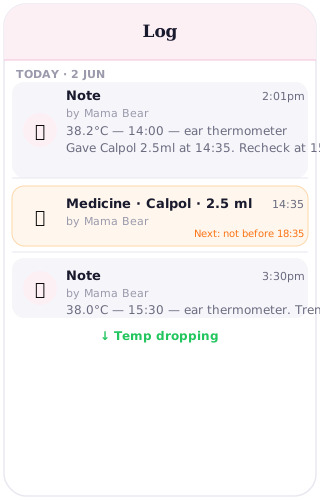
Why a single temperature reading tells you less than you think
When a GP asks "how long has the fever been running?", they are not asking for the current number. They are asking for the arc. A fever that started at 37.8°C eighteen hours ago and has steadily climbed to 39.1°C is a different situation from a fever that spiked to 39.2°C, came down after paracetamol, and has been sitting at 37.9°C for the last six hours. The treatment decision can be different. The level of concern is different.
If you arrive in the consulting room with one reading on your phone, the doctor has a data point. If you arrive with a timestamped log of seven readings over 24 hours, with notes on what you gave and when, the doctor has a clinical picture. That is a meaningfully better starting point for an 8-minute appointment.
What to log, and exactly how
Temperature goes into the Cubby notes section as free text. There is no separate temperature field, which is actually useful: it means you can capture everything in one place, not just the number.
Here is the format that works best. Write the reading, the time (the note is already timestamped but being explicit helps when you are reading it back fast), the thermometer type, and what you gave if anything:
- "38.2°C — 14:30 — ear thermometer — given Calpol 2.5ml at 14:00"
- "38.7°C — 17:15 — ear thermometer"
- "37.8°C — 20:00 — ear thermometer — settled after bath"
Three entries like that over an evening already show you more than any single reading could. The doctor can see the pattern, the medicine dose and timing, and the context. That is what a fever log is for.
The thermometer types, briefly
It matters which type you use, and it matters that you note it. The same number from different thermometers can mean different things clinically.
Ear (tympanic) thermometers are fast and widely used at home, but can vary slightly depending on placement. Underarm (axillary) readings are reliable for babies under 2 months and are often what health visitors recommend for newborns. Rectal is the most accurate method for newborns and remains the clinical standard in many countries, though it is less commonly used at home. Forehead (temporal artery) thermometers are convenient and increasingly popular, but are generally less precise than ear or rectal readings.
A reading of 38.5°C from an ear thermometer and a reading of 38.5°C from a rectal thermometer are not directly comparable. Write the method in every note. The doctor will interpret the numbers correctly if they know how you measured.
The timeline the doctor needs
When the doctor asks "when did it start?", the answer is in the first note you logged. When they ask "has it been responding to medicine?", the answer is visible in the pattern across your entries. When they ask "did it spike or creep up?", the timestamps show them.
A GP or paediatrician making a decision about a 48-hour fever wants the arc, not the latest number. If you can open Cubby in the consulting room and scroll through six or eight timestamped notes with readings, medicine doses, and context, you have handed them the information they need to make a good decision. That is a better appointment for everyone, and most importantly a better outcome for your baby.
The medicine link
You can log medicines separately in Cubby's medicine log, with name, dose, and time. When you are also taking temperature notes, the two create a picture together.
Paracetamol (Calpol and equivalents) can be given every 4 to 6 hours. Ibuprofen can be given from 3 months, every 6 to 8 hours. The two can be alternated to keep fever under control through longer stretches, though you should confirm this approach with your doctor for your specific baby. If you can see in the log that you gave medicine at 14:00, the temperature was 38.2°C at 14:30, dropped to 37.4°C by 17:00, and then climbed back to 38.8°C by 20:00, that is a complete clinical picture. The doctor knows the medicine worked initially and that the fever returned. That changes their assessment.
When to stop logging and call someone
The log is valuable, but there are moments when the right call is a phone or a drive, not another note entry.
If your baby is under 3 months and has any fever of 38°C or above, call your doctor or health service immediately. Do not wait to see if it develops. If your baby is 3 to 6 months and has a temperature of 39°C or above, call your doctor. At any age, if your baby has a fever alongside a rash that does not fade when you press a glass against it, difficulty breathing, is unusually limp or difficult to wake, or has a seizure, call emergency services.
In the UK, call NHS 111 for advice or 999 for emergencies. In the UAE, the health advice line is 800-HEALTH (800-43258) and the emergency number is 998. In India, contact your paediatrician directly or go to A&E. Your country's health authority is always the right reference for guidance specific to your situation.
Frequently asked questions
Is there a specific temperature tracker in Cubby?
Cubby does not have a separate temperature field. Temperature readings go into the notes log as free-text, timestamped entries where you write the reading, the thermometer type, and anything else relevant such as medicine given. Because notes are timestamped automatically, you build a fever log naturally over the course of a day or night.
How do I log my baby's temperature in Cubby?
Open the notes section and add a new entry. Write the temperature, the time, the thermometer type, and what you gave if anything. For example: "38.2°C — 14:30 — ear thermometer — given Calpol 2.5ml at 14:00." Repeat each time you take a reading. By the time you see the doctor you have a complete timestamped record.
What temperature is a fever in a baby?
A fever in a baby is generally defined as a temperature of 38°C (100.4°F) or above. For babies under 3 months, any fever of 38°C or above is a reason to contact your doctor or health service immediately. For babies 3 to 6 months, 39°C or above warrants prompt medical advice. Always follow the guidance of your doctor or local health authority.
Can I show my Cubby temperature notes to the doctor?
Yes. Open the notes log in Cubby on your phone and scroll through the entries during the appointment. Each entry shows the text you wrote and the timestamp. Doctors are used to patients showing them information on their phones, and a timestamped log with readings and medicine doses is exactly what they need to see a trend rather than a single number.
Should I log the thermometer type when tracking temperature?
Yes, and it matters clinically. A reading of 38.5°C from an ear thermometer and 38.5°C from a rectal thermometer are not directly comparable. Rectal is the most accurate method, ear can vary slightly, and underarm typically reads a little lower. Writing the method alongside the reading means the doctor can interpret the numbers correctly.
Start the log before the next reading
One note entry. Timestamped. The trend shows itself over time. No app store needed — works on any phone or browser.
Start free