Baby rituals in Cubby: building and tracking your daily rhythm
Somewhere around week six or eight, if you look back at the last few days of logs, you might notice a pattern starting to emerge. The morning feed tends to happen around the same time. The first nap comes roughly an hour and a half after that. There is a fussy window in the late afternoon that seems to happen most days. The evening wind-down follows a loose sequence that sometimes, on good days, leads to a longer overnight stretch.
That pattern is not something you designed. It is something your baby moved toward and you started to recognise. Cubby's Rituals feature is built around that moment: helping you see the pattern, share it with the people who help care for your baby, and track how the day is going against it, without any pressure for it to be perfect.
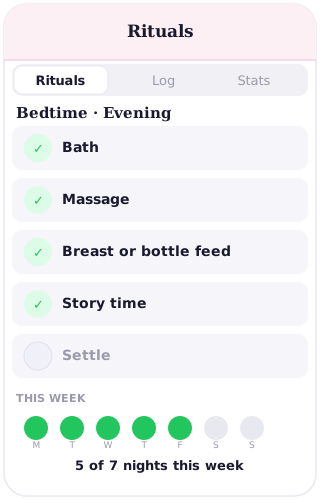
Why a rhythm matters (without being prescriptive)
A baby who has a loose daily rhythm tends to be easier to read. You know roughly when they will be hungry, which makes the hunger cues less ambiguous. You know roughly when they will be tired, which means you can start the wind-down before the overtiredness sets in. You are not flying completely blind.
None of this requires a rigid schedule. The anxiety that often comes with "baby sleep routines" is the anxiety of a schedule that must be followed exactly, where deviation means failure. A rhythm is different. It is a rough map of the day, not a timetable. When things run 45 minutes late because you had a long feed, that is the rhythm flexing, not breaking.
The value of having the pattern somewhere you can see it is that it reduces the mental load of carrying it in your head. You do not have to remember when the last nap was and whether the next one is due, because the log tells you. The pattern becomes something you can look at, not something you have to maintain by memory.
What Cubby's Rituals feature does
Rituals in Cubby lets you build your baby's day as a repeating pattern. You set up a sequence: the morning feed, awake time, nap, afternoon feed, another awake period, another nap. You give each step a rough planned time. The log then runs alongside the pattern so you can see, at any point in the day, where you are relative to it.
At the end of the week, Cubby gives you a gentle measure of how the week went: something like "5 of 7 mornings, the morning ritual happened within 30 minutes of planned." That is the whole measure. No streak. No score. No gamification. Just a quiet picture of how the week went, which you can use or ignore as you see fit.
The framing is deliberate. Cubby does not run streaks, because streaks create pressure and guilt. A week where two mornings went completely sideways is a normal week with a new baby. The log captures it accurately. The measure reflects it without judgment.
The circle and rituals
Any ritual you build in Cubby is visible to everyone in your family circle. This is where it becomes genuinely useful beyond the immediate parent.
Your nanny arrives and opens Cubby. They can see the morning ritual and where the day is up to. The 8am feed is logged. The first nap started at 10am. They know the pattern and they know what has happened so far, without you leaving a note or sending a WhatsApp. The ritual sits alongside the live log, and together they give the full picture.
A grandparent taking the baby for the afternoon can see the ritual for that time of day: what the nap pattern tends to look like, when a feed is likely due. They do not need to call and ask. They open the app and it is there.
Flexibility over rigidity
The word Cubby uses for this feature is "ritual," and that choice is not accidental. A routine implies obligation. A ritual implies warmth and intention. The morning feed and wind-down and bath and song are things you do with your baby, not tasks you execute on a schedule.
The Rituals feature in Cubby is built around that framing. It helps you notice and share the pattern your baby is already in. It measures loosely and without judgment. It does not send you a notification when you are 10 minutes late for a nap. It does not tell you that you have broken a streak.
What it does is give you a map. A map you can share with the whole circle, update when the pattern changes, and look back at when you want to see how the week went.
When rituals help most
There are a few moments when having a ritual in Cubby makes a particularly visible difference. The first is the newborn weeks when you are trying to establish any rhythm at all. Having even a simple ritual logged gives you something to look back at and notice: is a pattern emerging? Is it shifting?
The second is going back to work. When you hand the day over to a nanny or a family member, a shared ritual means they know the intended shape of the day without a long briefing. The third is any transition: starting nursery, changing feeding approach, introducing solids. The ritual gives you a baseline to compare against as things shift.
Frequently asked questions
What is the difference between a ritual and a routine in Cubby?
Cubby uses the word ritual deliberately. A routine implies a fixed schedule that must be followed exactly. A ritual implies warmth, intention and rhythm. The Rituals feature is designed to help you see and share your baby's daily pattern without the pressure of a timetable. Awareness, not enforcement.
Can I share my baby's ritual with a nanny or grandparent?
Yes. Any ritual you build in Cubby is visible to everyone in your family circle. Your nanny or grandparent can open Cubby and see the planned pattern for the day alongside the actual log of what has happened. No verbal briefing needed.
What happens if our ritual changes — can I update it?
Yes. Rituals can be updated any time. Babies change quickly and so do their rhythms. If your baby drops a morning nap or feeding times shift, you update the ritual to reflect the new pattern. The log continues from where it left off.
Will Cubby remind me when a ritual step is due?
Cubby shows your ritual alongside the live log so you can see at a glance what the pattern says should be coming next and what has actually happened so far. Cubby's push notifications are reserved for medicine reminders, not ritual steps, to keep things calm rather than noisy.
Is Cubby's ritual feature suitable for newborns?
Yes. With newborns there may not be a clear pattern yet, and that is fine. The feature is useful from the moment you start seeing any rhythm at all, even a loose one. Start with a very simple ritual and build from there as the pattern becomes clearer over weeks.