Tracking your baby's growth in Cubby: weight, length and head circumference
Why growth matters in the first year
Weight is the single most-checked number in a baby's first year. At every health visitor or paediatrician appointment, it gets measured and plotted. The question is always the same: is this baby growing steadily on their own curve?
It is not about hitting a specific number or a specific percentile. Two babies born the same week can sit at the 10th and 90th centile and both be perfectly healthy. What matters is the pattern over time. A baby who is steadily tracking along their own curve, whatever that curve is, is doing well. A baby who drops sharply over a few weeks is worth a closer look.
To see that pattern, you need a record. Not a memory of a memory, not a figure scrawled in a red book you have to hunt for, but a clean timeline of measurements with dates.
What Cubby logs
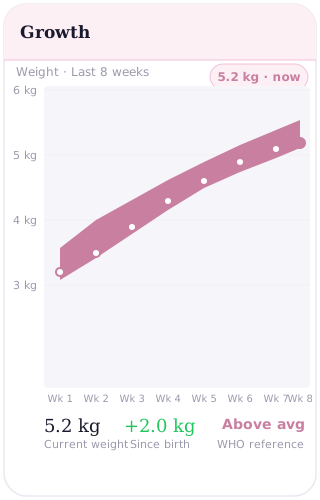
In Cubby's growth section you can log three measurements: weight in kilograms or pounds, length or height in centimetres or inches, and head circumference in centimetres. Each entry is timestamped when you save it. Log after every weigh-in and you have a running timeline of your baby's growth, with the exact date of each measurement.
That is the complete picture. Not a single snapshot from the last appointment, but a series of data points that show direction and speed of change.
Using the log at appointments
At every health visitor or paediatrician appointment, one of the first questions is how the baby's been doing. How are feeds going? How is the weight tracking? With Cubby, you have the last several weigh-ins with exact dates on your phone. You can show the screen in the consulting room.
This matters more than it sounds. Clinicians are trying to assess a trend from a small number of official measurements. If you have additional home weigh-ins or clinic visits logged between appointments, that is more data points for the conversation. And if something has changed, having the dates and numbers means you can say "she was 5.4 kg on the 3rd and 5.6 kg on the 17th" rather than "I think she gained about 200 grams this month, maybe."
What Cubby does not do
It is worth being honest here. Cubby logs your baby's measurements and keeps a dated record of them. It does not automatically plot those numbers against WHO or national growth chart centile curves. Your health visitor or paediatrician has the clinical charts and the training to interpret where your baby sits on them. Cubby is the record; the clinical team is the interpreter.
Cubby is also not a diagnostic tool. If you are worried about your baby's growth, the right move is always to call your health visitor, GP or paediatrician. The log helps you have that conversation with real data rather than approximations.
The trend, not the number
The point of the log is not any single measurement. It is the direction. A baby who drops noticeably over four weeks, relative to where they were tracking before, is worth a conversation with your doctor. A baby who is gaining steadily, week after week, is doing what they should be doing.
Cubby's log gives you the timestamps to see that direction clearly, and to bring it to your clinical team with evidence rather than uncertainty. That is the difference between a worried parent saying "I think something is wrong" and a parent who can say "here are six weigh-ins over eight weeks, and this is the pattern."
Weight and length together
Paediatricians often look at weight-for-length as well as absolute values. A baby who is long and heavy may be exactly where they should be even if their weight alone looks high. A baby who is short and light may be proportionate and healthy. Logging both measurements in Cubby gives you the data to have that more complete conversation at your next appointment.
Frequently asked questions
What measurements should I log for my baby's growth?
The three standard measurements are weight (in kilograms or pounds), length or height (in centimetres or inches), and head circumference (in centimetres). Cubby lets you log all three with a timestamp so you have a complete growth timeline.
How often should I weigh my baby and log it in Cubby?
Log after each official weigh-in at your health visitor or paediatrician appointment so your record matches your clinical history. You can also log any additional weigh-ins done at home or at a pharmacy. In the early weeks, weigh-ins may be weekly; they become less frequent as your baby gets older.
Does Cubby show growth charts?
Cubby logs your baby's measurements and keeps a timestamped record. It does not plot those numbers against WHO centile curves automatically. Your health visitor or paediatrician has the clinical charts. Cubby gives you the accurate, dated data to bring to that appointment.
My baby has dropped centiles. Should I be worried?
A centile drop is something to discuss with your health visitor or paediatrician, not interpret on your own. Some drops are normal; others are worth investigating. What Cubby gives you is an accurate timestamped record so the conversation with your clinical team is grounded in real data rather than estimates.
Can I log weight in pounds as well as kilograms?
Yes. Cubby supports kilograms and pounds for weight, and centimetres and inches for length and height. Log in whichever unit your scales or your health visitor uses.
Log the numbers. See the trend.
Every weigh-in in one place, ready for your next appointment.
Start free