The coordination problem every new parent hits (and why it's so hard to solve)
The scene: 3am, a crying baby, and a question you can't answer
It is three in the morning. Your baby woke up crying twenty minutes ago and you have been trying to settle them ever since. You are the one who was not on shift. Your partner fed at midnight and then went back to sleep, and now you are standing in the half-dark trying to figure out the most basic thing: did they eat? When? How much? Is this hunger again, or wind, or just the ordinary discomfort of being a small person in an unfamiliar world?
You do not want to wake your partner to ask. They need the sleep. You are not even sure they would remember the details if you did. So you make a guess and go with it.
This moment, played out in some version every single night by almost every new parent, is the coordination problem. It is not dramatic. It is not a crisis. It is just the quiet friction that builds up when two people are trying to care for one small person across interrupted sleep, with no shared record of what happened.
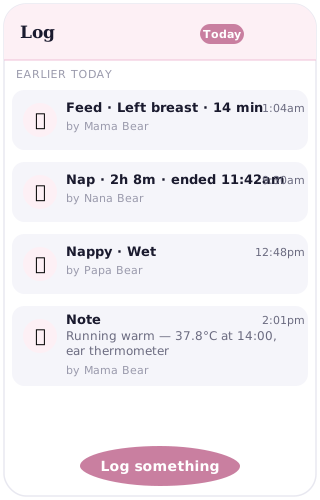
The two-person problem: shift handover at home
Most parents go into the newborn stage with the best of intentions about sharing the load fairly. What they discover quickly is that fair sharing requires information sharing, and information sharing turns out to be surprisingly hard at 3am.
In any given 24-hour period, one parent often ends up knowing significantly more than the other. Whoever was on the last shift knows when the baby last ate, how long the feed took, whether they settled well or fussed for an hour, whether there was a nappy change and what was in it. The other parent knows almost none of this when they take over, because the handover happened in a half-asleep mumble, or it did not happen at all.
This information gap creates real tension. Decisions that should be straightforward become uncertain. Did they drink enough today? Is this unsettled behaviour hunger or something else? Should we be worried about how little they slept this morning? Without a shared picture, each parent is working from incomplete information and second-guessing the other's calls. "You should have woken me if they fed twice in a row." "Why didn't you log that?" "I thought you were keeping track."
None of this is anyone's fault. It is just what happens when two exhausted people try to coordinate care with no shared system.
It gets wider: grandparents, nannies and the fragmented handover
For many families, the care circle extends beyond two parents. A grandmother who takes the baby on Tuesday afternoons. A nanny who does the morning shift while you work from home. A father-in-law who helps out at the weekend. A nursery two days a week.
Each additional person who cares for your baby adds another handover point, and each handover point is a place where information can get lost. The nanny's log is a piece of paper left on the kitchen counter. The grandparent's update is a WhatsApp message in the family chat, which gets buried under the memes by the time you look for it. The nursery gives you a printed daily summary that you shove in the bag and forget to read.
By the end of a day in which three different people have cared for your baby at different times, assembling a complete picture of what happened requires finding four separate sources of information, assuming anyone wrote anything down at all. Usually, someone did not.
The mental load: the invisible keeper of everything
In most households with a new baby, the information problem does not stay evenly distributed for long. One parent, usually but not always the mother, gradually becomes the keeper of everything. They are the one who knows when the last vaccine was, what the doctor said at the last check-up, which formula this baby tolerates, what the sleep consultant recommended, what the rash looked like before it went away, when the next jab is due.
They become the oracle. Everyone else asks them. "Can she have that?" "When did he last nap?" "Did we give the medicine this morning?"
Being the oracle sounds, on the surface, like a form of being needed. In practice it is exhausting. It is a form of invisible labour that runs continuously in the background of everything else you are doing. You cannot fully switch off, because the information lives only in your head and your head is never really off duty. Taking a break means being available to answer questions during the break. Going back to work means still being the source of truth for the person at home.
The mental load of baby care is not just the doing of it. It is the knowing of it, all of it, all the time.
Why it matters: decisions made without the full picture
The coordination problem is more than an inconvenience. Not knowing what your baby has had makes decisions genuinely harder.
Did they drink enough milk today? You need to add up feeds across four different shifts by three different people to know. Is this rash new, or was it there yesterday? You would need to remember what you saw 36 hours ago while running on four hours of sleep. When is the next vaccine due, and is it the same one you were told about at the last visit or a different one? Did someone already give the afternoon painkiller, or is it still due?
Each of these questions is answerable. But without a shared log that everyone updates, answering them requires either a reliable memory (which sleep deprivation specifically degrades) or a reliable system that nobody has yet set up.
The gap between "I think they had enough today" and "I know they had enough today" is a quiet but persistent source of parental anxiety. Most of that anxiety is preventable.
What actually helps
The honest answer is that most of the fixes people try do not quite work. A notebook on the sideboard works until someone forgets to update it. A notes app on your phone works until it is your partner's phone. A group chat works until the thread gets busy and the feed information is forty messages up. A spreadsheet works for about three days.
What actually helps is a shared, real-time log that is specifically designed for this: one place where everyone who cares for the baby can record what they did, immediately, and everyone else can see it without asking. Not a general-purpose tool repurposed for baby care. A log built for it, that understands the difference between a breast feed and a bottle feed, that knows when the next vaccine is due, that is organised around shifts and handovers and the specific things parents need to track.
Cubby is built specifically for this: a shared real-time log that everyone in your baby's care circle can see and update.
One log for everyone who helps
Cubby keeps your whole care circle in the picture — from partner to grandparent.
Start free